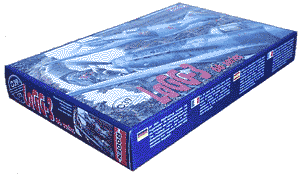
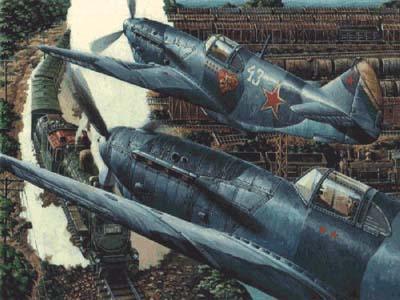
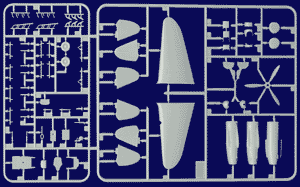
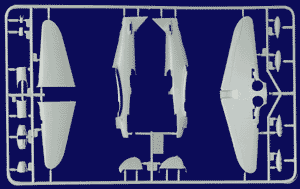
In the spring of 1940, a group of designers directed by S.Lavochkin, V.Gorbunov and M.Gudkov proposed a new experimental fighter to be built for test flight - the "I-301". As a result of shortages concerning metallic materials, basic construction was made using "delta-wood", or wood soaked in special phenolic resins. The aircraft was powered by a 1050h.p. M105P liquid-cooled engine enabling it to reach speeds of 605 km/h - it was faster than a modified "Me-109", Germany's main fighter.
Production of the new plane, named the LaGG-1, was started just before the end of flight testing, the plane's construction being developed in time for production to proceed serially.
Additional fuel tanks were installed in the replacement wing sections. This modification gave longer range and was named the LaGG-3, and five aircraft factories started production of this type.
In 1942 the LaGG-3 designers developed its performance characteristics according to CAGI and NII VVS (Science institute of the Air Force) recommendations. As a result, the series 66 LaGG-3 had appeared, being the last modification of this type. Series 66 production lasted from the spring of 1943 to the summer of 1944. Some of them were used against the Japanese Army during August of 1945.
Performances:
- Wingspan: 9.8 meter
- Length: 8.81 meter
- Takeoff Weight: 2700 kg
- Speed: 605 km/h
- Flight Range: 1000 km
- Engine: M-105PF
- Engine Power: 1180 hp
- Armament:
- Cannon: 1 x 20 mm ShVAK
- Machine Gun: 1 x 12.7 mm UBS
- Rockets: 6 x 82 mm RS
- Bombs: 2 x 50 kg